
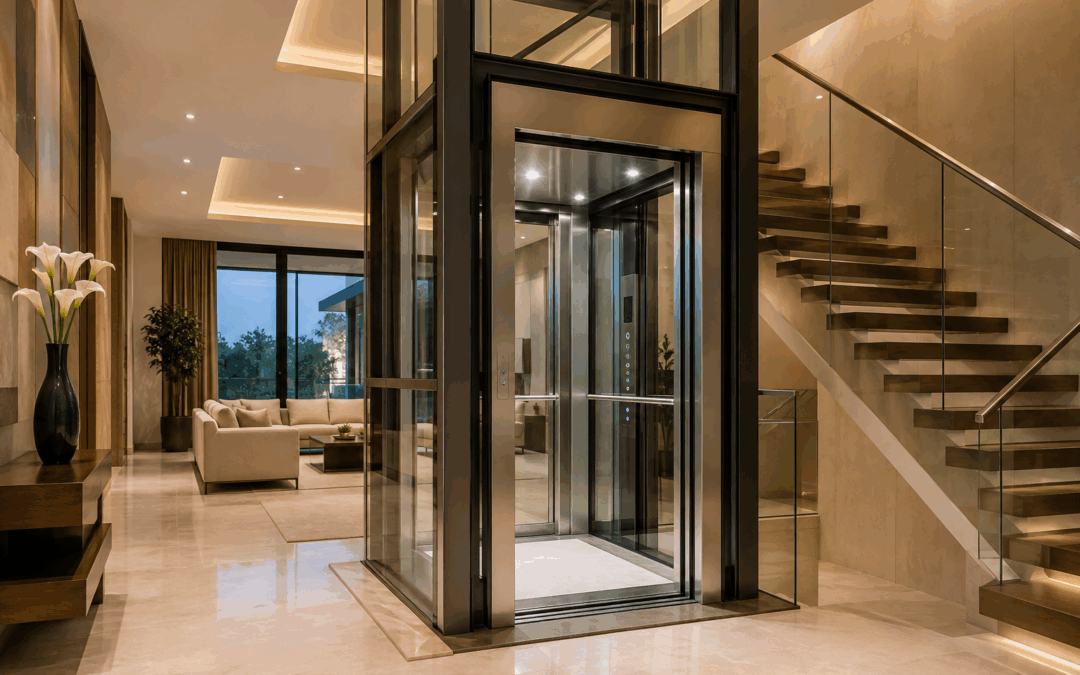
A Villa Lift is no longer considered only a luxury feature in Dubai homes. For many homeowners, it has become a practical addition that improves accessibility, convenience, comfort and long-term usability of a multi-storey property.
Whether you are building a new villa, renovating an existing home or looking for a safer way for elderly family members to move between floors, installing a Villa Lift in Dubai can provide a practical and stylish solution.
However, before choosing a lift, homeowners usually have three major questions:
- What type of Villa Lift should I install?
- How much space will the lift require?
- How much does a Villa Lift cost in Dubai?
The answers depend on your property layout, number of floors, available space, lift capacity, design preferences and the amount of structural work required.
This guide explains the main types of villa lifts, space requirements, installation considerations and expected costs to help you plan your project correctly.
What Is a Villa Lift?
A Villa Lift is a residential elevator designed specifically for private homes, villas, duplexes and low-rise residential properties.
Unlike large commercial passenger elevators, residential lifts can often be designed with smaller footprints and lower passenger capacities. Certain systems can also reduce the need for large machine rooms, deep pits or extensive structural modifications.
Modern villa lifts can be customised with features such as:
- Glass walls
- Stainless-steel finishes
- Designer cabin interiors
- Automatic doors
- LED lighting
- Touch controls
- Emergency communication systems
- Backup power
- Multiple entrance configurations
- Accessibility-friendly cabin layouts
Royal Fuji Star provides villa and home lift solutions designed around the available property space, required capacity and architectural style of the residence.
Why Are Villa Lifts Becoming Popular in Dubai?
Dubai has a large number of multi-level villas, townhouses and luxury residences. Adding a residential lift can make daily movement throughout these homes much easier.
Improved Accessibility
One of the main reasons homeowners install a Villa Lift is accessibility.
Older family members, people with limited mobility and wheelchair users may find stairs difficult or uncomfortable. A properly planned residential lift can provide safe movement between floors while allowing residents to remain independent within their homes.
Everyday Convenience
Villa lifts are also useful for transporting:
- Groceries
- Luggage
- Laundry
- Household items
- Children’s equipment
- Heavy packages
Instead of carrying these items through staircases, residents can move them between floors conveniently.
Future-Proofing Your Villa
A villa that works perfectly for a young family today may become difficult to navigate later.
Installing a home elevator in Dubai can help prepare the property for changing mobility requirements as residents grow older.
Luxury and Interior Design
A modern Villa Lift can also become an architectural feature.
Glass cabins, panoramic shafts, premium lighting and custom interiors allow the lift to complement contemporary villa designs rather than appearing like an industrial installation.
Royal Fuji Star also provides glass and panoramic elevator solutions for homeowners looking for a stronger architectural statement.
Types of Villa Lifts Available in Dubai
There is no single lift system suitable for every property. The ideal solution depends on your available space, number of floors, expected users, budget and construction conditions.
1. Hydraulic Villa Lift
A hydraulic lift uses a hydraulic system to raise and lower the lift cabin.
Hydraulic systems are commonly considered for low-rise residential properties because they can provide smooth operation and good passenger comfort.
Hydraulic Villa Lifts are suitable for:
- Two-storey villas
- Three-storey villas
- Larger residential cabins
- Homes requiring smooth travel
- New-build projects with provision for a lift
Before selecting a hydraulic system, the technical team should assess pit requirements, equipment placement and structural conditions.
2. Machine-Room-Less Villa Lift
A Machine-Room-Less or MRL elevator integrates much of the lift machinery within the shaft instead of requiring a traditional separate machine room.
This can help reduce the overall space needed for the lift installation.
MRL lifts are popular in modern projects where homeowners want efficient vertical transportation without dedicating additional space to a large machine room.
They can be a good choice when designing a Villa Lift into a new residence from the planning stage.
3. Platform Lift
A platform lift can provide a compact mobility solution where space is limited.
Depending on the model, platform-based residential lifts can require less structural work than conventional passenger elevators.
Some modern UAE home-lift systems are designed to work within footprints close to approximately one square metre, although exact dimensions vary considerably between manufacturers and models.
Platform lifts may be particularly useful for:
- Existing villas
- Smaller properties
- Retrofit projects
- Accessibility applications
- Homes where major structural modification should be avoided
4. Panoramic or Glass Villa Lift
For luxury villas, the lift can form part of the interior design.
A panoramic Villa Lift uses glass panels around the cabin, shaft or both to produce an open and contemporary appearance.
Glass lifts work particularly well near:
- Open staircases
- Double-height areas
- Villa entrances
- Atriums
- Living spaces
- Feature walls
Royal Fuji Star offers glass lift solutions designed to combine vertical mobility with architectural appeal.
5. Structural or External Villa Lift
Sometimes there simply is not enough suitable space inside an existing villa.
In these situations, an external structural lift may be considered.
A supporting structure can potentially be constructed outside the main building and connected to the required floors.
This solution requires careful structural evaluation, architectural coordination and relevant approvals, but it can provide an alternative for properties where internal installation is impractical.
How Much Space Is Required for a Villa Lift?
One of the biggest misconceptions about installing a Villa Lift is that every residential elevator requires a huge shaft.
Modern residential lift systems are available in many sizes.
Some compact UAE home lift models advertise installation spaces of approximately 0.9 to 1 square metre, while larger passenger and accessibility-focused lifts naturally require significantly more room.
However, cabin dimensions alone should never be used to determine whether a lift will fit.
A technical assessment must consider several measurements.
1. Lift Cabin Size
This is the usable space available to passengers inside the elevator.
A small cabin may be suitable for one or two passengers, while families wanting comfortable multi-passenger or wheelchair use should plan for a larger cabin.
2. Lift Shaft Size
The shaft is normally larger than the actual passenger cabin because room is required for the elevator structure, guide rails, doors and operating equipment.
The required shaft dimensions vary according to the selected lift technology.
3. Pit Depth
Traditional elevator systems may require a pit beneath the lowest landing.
However, some modern home lift systems have very shallow pit requirements or can use alternative configurations.
Current residential products available in the UAE demonstrate how pit requirements can vary significantly between lift technologies, with some compact systems using little or no conventional deep pit.
4. Headroom
Headroom refers to the vertical clearance required above the highest lift landing.
This must be checked carefully during the site survey, especially when installing a Villa Lift inside an existing property.
5. Door and Landing Space
Enough clear space must be available outside every lift entrance so passengers can enter and exit safely.
The position and direction of the lift doors also affect the overall space requirement.
What About Wheelchair Accessibility?
If the Villa Lift is intended for wheelchair accessibility, additional space should be considered from the beginning.
As a useful accessibility reference, the Dubai Universal Design Code specifies a minimum 1,200 mm x 1,500 mm cabin for certain one-door accessible elevators in public areas, together with a minimum 900 mm door width and clear manoeuvring space outside the lift.
These dimensions should not automatically be treated as the required specification for every private villa. Requirements can depend on the property’s classification, lift type and approving authority.
Your lift provider and building consultant should therefore confirm the applicable requirements before finalising the design.
Where Can a Villa Lift Be Installed?
A professional site inspection usually determines the best location.
Possible installation areas include:
Inside the Staircase
Large stairwells sometimes contain an unused central void that can accommodate a compact lift structure.
This can be one of the cleanest solutions because the lift remains integrated with the existing circulation area.
Beside the Staircase
The lift can sometimes be positioned adjacent to an existing staircase, depending on floor openings and available space.
Inside an Unused Room or Corner
Storage rooms, unused corners or other spaces aligned vertically across multiple floors may sometimes be converted into a lift location.
In an Atrium or Double-Height Area
Modern villas often contain open spaces that can accommodate a panoramic glass lift without compromising the overall design.
Outside the Villa
An external structural lift can be considered when internal space is unavailable.
The most suitable location should be determined only after reviewing the architecture, structural conditions, floor alignment and required approvals.
Installing a Villa Lift in a New Villa vs an Existing Villa
New Villa Installation
The ideal time to plan a Villa Lift is during the architectural design stage.
Planning early allows the architect, structural engineer and lift company to coordinate:
- Shaft dimensions
- Floor openings
- Electrical requirements
- Pit requirements
- Headroom
- Door positions
- Structural loads
- Cabin size
This usually reduces later modifications.
Existing Villa Installation
Installing a lift in a completed property requires more detailed planning.
The site assessment must identify:
- Available vertical space
- Suitable structural locations
- Existing beams and slabs
- Electrical supply
- Floor-to-floor heights
- Possibility of creating openings
- Interior finishing requirements
Compact lift systems can make retrofitting possible even when the original villa was not designed with an elevator.
How Much Does a Villa Lift Cost in Dubai in 2026?
There is no universal fixed price for Villa Lift installation.
Current published 2026 UAE residential lift pricing demonstrates a wide market range. Depending on lift technology, number of stops, size and specifications, many residential lift systems fall broadly within approximately AED 80,000 to AED 250,000, while simpler configurations may fall below this range and highly customised luxury installations may exceed it.
This should be treated only as general market guidance, not as a Royal Fuji Star quotation.
An accurate price requires a technical site assessment.
Factors That Affect Villa Lift Cost
Number of Floors
A G+1 villa normally requires fewer stops than a G+2 or G+3 residence.
Additional floors increase the travel distance, components and installation requirements.
Lift Technology
Hydraulic, traction, platform and other residential systems use different equipment and installation methods.
This directly affects project cost.
Cabin Size
A larger Villa Lift designed for several passengers or wheelchair accessibility will generally cost more than a compact residential model.
Shaft Construction
If a suitable shaft already exists, civil work may be lower.
Creating a completely new shaft or external structure can increase the project budget.
Glass and Premium Finishes
Luxury options such as:
- Panoramic glass
- Stainless steel
- Decorative wall panels
- Custom flooring
- Premium lighting
- Special control panels
can increase the final lift price.
Door Configuration
Single-entry, opposite-entry and adjacent-door configurations can have different structural and equipment requirements.
Civil and Structural Work
Cutting floor slabs, creating a pit, modifying walls or constructing a steel structure may be priced separately from the elevator equipment.
Maintenance
Homeowners should also consider long-term servicing and maintenance instead of comparing only the initial installation price.
Safety Features to Look for in a Villa Lift
Safety should be one of the most important factors when choosing a residential lift.
Look for features such as:
- Emergency stop system
- Automatic Rescue Device or emergency lowering
- Backup power
- Door interlocks
- Obstruction sensors
- Overload protection
- Emergency communication
- Non-slip flooring
- Alarm system
- Proper landing protection
Lift installation, testing and ongoing inspection must also follow applicable local regulations and technical requirements.
Dubai Municipality currently lists technical guidance covering examination and certification of cranes, hoists, lifts and other lifting appliances, reinforcing the importance of professional inspection and compliance.
Villa Lift Installation Process
A professional Villa Lift installation in Dubai normally follows several stages.
Step 1: Site Inspection
The lift company assesses the property, available space, floor levels and structural conditions.
Step 2: Lift Selection
The appropriate lift technology, passenger capacity, number of stops and configuration are selected.
Step 3: Design and Planning
Shaft dimensions, cabin size, door positions, finishes and technical requirements are finalised.
Step 4: Civil and Structural Preparation
Any required shaft construction, openings, pit preparation or electrical work is completed.
Step 5: Lift Installation
The lift components, cabin, doors, controls and safety systems are installed.
Step 6: Testing
The system undergoes operational and safety checks before handover.
Step 7: Handover and Maintenance
The homeowner receives operating instructions and should establish an appropriate maintenance schedule.
Royal Fuji Star’s existing villa lift guidance similarly describes site assessment, customisation, installation, testing, handover and ongoing maintenance as key parts of the process.
How to Choose the Right Villa Lift in Dubai
Before making a final decision, consider these questions:
How many floors must the lift serve?
Calculate the required number of stops.
Who will regularly use the lift?
Consider elderly residents, children and wheelchair accessibility.
How much space is available?
A site inspection can determine whether a compact internal, stairwell or external solution is most appropriate.
What capacity is required?
Avoid selecting a lift purely because it has the smallest footprint.
Do you prefer functionality or a luxury feature?
A basic enclosed cabin and panoramic glass lift have very different design objectives.
How much civil work is required?
The cheapest lift equipment may not result in the lowest overall project cost if extensive structural modifications are necessary.
What maintenance support is available?
Reliable after-sales support, spare parts availability and preventive maintenance are important for the long-term performance of the elevator.
Why Choose Royal Fuji Star for Villa Lift Installation in Dubai?
Choosing the right elevator is only part of the project. Correct planning, installation and after-sales service are equally important.
Royal Fuji Star provides elevator solutions for residential properties across Dubai and the UAE, including installation, repair, maintenance and modernisation services.
For Villa Lift projects, the team can assess the property and recommend a solution based on:
- Available installation space
- Number of floors
- Passenger requirements
- Lift capacity
- Interior design
- Accessibility requirements
- Structural conditions
- Budget
A professional site assessment is the best way to determine the correct elevator rather than selecting a lift based only on online dimensions or advertised prices.
Installing a Villa Lift in Dubai can transform how residents move around a multi-level home.
From compact platform solutions to hydraulic lifts and luxury panoramic elevators, homeowners now have multiple options for both new villas and existing properties.
The most important step is proper planning.
Available space, cabin dimensions, shaft requirements, number of floors, passenger capacity, civil work, safety requirements and long-term maintenance should all be evaluated before choosing a system.
Although 2026 UAE market prices for residential lifts can broadly range from around AED 80,000 to AED 250,000 or more depending on specification, the only reliable way to determine the actual Villa Lift cost in Dubai is through a professional site inspection and customised quotation.
Looking for a Villa Lift in Dubai?
Contact Royal Fuji Star Elevators & Escalators for a professional site assessment and customised Villa Lift solution designed around your property, space and requirements.
Frequently Asked Questions
How much does a Villa Lift cost in Dubai?
Villa Lift prices vary according to the lift type, number of floors, cabin size, shaft requirements, finishes and civil work. Current UAE residential lift pricing shows a broad market range of approximately AED 80,000 to AED 250,000 for many configurations, although simpler systems can cost less and luxury installations can cost more. A site inspection is required for an accurate quotation.
How much space do I need for a Villa Lift?
There is no single minimum size for every residential elevator. Certain compact home lift systems can fit within approximately 0.9 to 1 square metre, while conventional passenger or wheelchair-friendly lifts require more space. Shaft size, landing clearance, pit and headroom must also be considered.
Can a lift be installed in an existing villa?
Yes. Many existing villas can be retrofitted with a residential lift. Possible locations include the stairwell, beside a staircase, within an unused room or through an external structural shaft. A technical inspection is required to determine feasibility.
Which type of lift is best for a villa?
The best Villa Lift depends on available space, floors, passenger capacity, accessibility needs, budget and interior design. Hydraulic, MRL, platform and panoramic lift configurations can all be suitable for different residential projects.
Does a Villa Lift require a machine room?
Not always. Some modern residential elevator systems are machine-room-less or integrate operating equipment within the lift structure.
Can I install a glass lift in my villa?
Yes. Panoramic and glass lifts are popular in luxury villas, especially in atriums, entrance areas, open staircases and double-height spaces.
Does a home lift need a pit?
It depends on the lift technology. Traditional systems may require a pit, while certain compact residential elevators require only a shallow pit or alternative installation arrangement.
Is a Villa Lift suitable for elderly residents?
Yes. Improving mobility for elderly residents is one of the main reasons homeowners install residential lifts. Cabin dimensions, door width, controls and accessibility features should be selected according to the user’s requirements.